Thursday, July 2, 2009

Pain Management: Week Two (& Thursday Week One)

The pain management course is taking up almost all of my energy right now - it's great, it's helping me a lot, but it's also very exhausting.

Thursday Week One

Thursday sessions start with group psychotherapy, then hydro again, lunch, a half-hour 'education' session on various topics, physiotherapy, then relaxation.

The group psychotherapy last Thursday wound up being largely an introduction thing - Kon talking about what the therapy is about, getting to know us, us knowing him. He introduced the 'helpful thinking' concepts, and the underlying concept of CBT.

That concept is: events happen. How we think about these events affects our emotional reactions, and our behaviour. For instance, if you miss the bus, you might think 'oh my god, I'll be late for work, I'll get fired, then I won't be able to pay the rent and I'll end up homeless'. Or you might think 'oh well, no big, I'll have a few minutes to relax now and I'll be in a better state for work when I do get there'.

Same event, different thoughts. Of course, if your boss really is going to fire you, the second set might need to be modified slightly! Possibly to 'well, this guy was crap to work for anyway, maybe I'll stop in at the newsagent and check the job ads while I wait'....

So. Next was hydro - still a lovely warm pool, I still really like it. My side was aching somewhat by the time I finished, but the reason for that was probably hormonal. The ladies will know what I mean ...

After lunch was a talk about sleep, and 'sleep hygiene' - all pretty standard stuff if you're familiar with the 'sleep hygiene' thing. If you're not, a quick Google search showed a couple of .edus that talk about it. Sleep Hygiene from the University of Maryland and Sleep Hygiene from Stanford


Physiotherapy was more difficult than it had been on the Tuesday, but again, it was due to hormonal cramping and not the physiotherapy itself. I mentioned the problem, and Justin pointed out that this is still a pain issue, even if it's not my major pain problem. So we treated it as an opportunity to find out what my exercise tolerance is while in pain.

The relaxation session was very, very welcome. The techniques they're using are all ones I'm accustomed to, but the regular and extended relaxation sessions are doing me good. I need to make a point of doing this myself.

The drive home, however, was pure torture. The cramping was very, very bad, and every expansion joint, crack in the asphalt, speed bump, or other non-flatness in the road jolted the cramping muscles and caused a spike of pain.

This, along with anxiety attacks and continued cramping over the weekend and on the Monday, meant that by Tuesday, I was a mess.

Tuesday Week Two

I'd had a panic attack on the Monday night, was in pain, and was in a state where I could barely think. All I wanted to do was curl up in bed and pretend the world didn't exist.

But I went to the course. I was terrified that they'd tell me to 'buck up', 'keep a stiff upper lip', or even accuse me of 'putting it on' or 'acting sicker than I was'.

All of these, of course, are the usual responses I get. Even from family members (not Feldie and Tateru, though!).

I didn't get them from the pain clinic people. I was so relieved. In fact, they were very pleased I was there, and pleased to be able to actually see the difference between me-normal (Tuesday week one) and me-sick (Tuesday week two).

The OT (occupational therapy) session was on shopping, and quite frankly I remember very few of the details about it! But shopping, when you look at it from an OT point of view, is a massive task! It's also one that is very difficult to pace - to divide up into smaller units and take rest breaks between the units.

You have to dress, which itself can be a considerable effort. Travel to the shop. Select a trolley which won't make things worse for you (they recommend bringing your own shopping trolley!). Then you have to select the goods, which includes a lot of bending, lifting, even carrying. And a fair bit of walking, which is strenuous for some. At the checkout, there's concentrated bending, lifting and carrying. Then bagging (sometimes), and getting the things to, then in the car, going home, getting them out, more lifting and carrying, and finally putting the cold stuff away. Then collapsing on the couch while the nonperishables wait for you to have energy again.

Online grocery shopping can be a godsend.

So. After that, hydro - I didn't even have the energy to play in the water. I just did the exercises, had a shower, got dressed, and collapsed for lunch. The physios supervising the hydro kept an eye on me, I think they were a bit worried.

I also rested in the relaxation room after I ate lunch. I think I slept.

Justin and Erika (Catherine was away) controlled the pacing of my physiotherapy, sending me for regular rest breaks. And I was not to worry about trying to get the whole program done - anything would be good enough.

The relaxation room was very, very welcome.

I think I was almost incoherent at poor Kon (my psychiatrist). I don't remember much of what we talked about, except that he very carefully probed to figure out whether my depression and anxiety are most likely to be biological (anatomic or neurochemical), circumstantial, or simply lifestyle based. (As in, if you don't put yourself in positions where happiness is possible, you're not going to be happy.)

He's talking to my pain doctor, and they're going to work on appropriate scripts for me. He's pretty damn sure that at least some of it is biological.

I don't remember much about the trip home on Tuesday. I may have fallen asleep while Feldie was driving me. Maybe not. I was drained. Not just exhausted, but I had nothing left to give.

Thursday Week Two (today)

After the sleep Tuesday night and a fairly relaxed Wednesday, I felt a lot better. Though Feldie points out that I did a lot of housework on Wednesday. And I baked.

FELDIE AND TATERU BOUGHT ME AN OVEN!

I love baking. It's very relaxing, and it produces yummy goodnesses. And since we moved into this house, we've not had an oven. The one that came with it is, quite frankly, so old and rusted we're sure it's dangerous and have never dared use it. The grill is equally off limits, being part of the same unit. One of the stovetop burners, we've taped over the dial to prevent us from forgetting and using it, the other three we do use - but carefully.

But now we have an oven! It's a little benchtop unit, and it was on sale for something like half price. And I love it! And I made my special recipe - passionfruit bikkies (cookies for the Americans). Anyway, I took some with me today, and shared them around.

Okay. So. Psychotherapy, we continued with the Helpful Thoughts thing. Hydro was lovely, and I spent a bit of time relaxing, and a short bit of water-play, as well as my exercises.

After lunch we had a session with CRS - Commonwealth Rehab Services. They're the government-run thing for getting disabled people back into the workforce. They might be helpful for after the program, or maybe someone else would be better. I don't want to be pushed into work too soon for my body. :(

Then physiotherapy, and Justin and Catherine were delighted that I hadn't had a pain flare after Tuesday! And Catherine gently scolded me when I went through my program too quickly - I must learn to pace my stupid body. Give it enough rests between bits of work.

Relaxation again. And then home. And once again, I napped shortly after I got home.


The Passionfruit Biscuit/Cookie Recipe

125g butter or margarine
1/4 metric cup of caster sugar (finer than table sugar, coarser than icing sugar)
1 egg, beaten
1 1/4 metric cups of SR flour (or plain flour + baking soda, to make it rise)
1 or 2 passionfruit OR 1 small tin passionfruit
Milk (optional)

Baking tray
Extra butter/marge or baking paper to grease/line the tray
Wire cooling rack
Sieve & bowl
Scales if possible
Measuring cups
Mixing bowl
Powered blender (ideal) or fork (and patience, and strong stirring arms)
Teaspoons
Oven! (You'll want it at 180C or so)


  • Grease a baking tray with a little bit of extra butter or margarine, or paper it with baking paper.
  • If using a tin of passionfruit, put the contents into a fine sieve, catching the syrup in a bowl and the seeds and pulp in the sieve.
  • If the butter is hard, put it in the microwave or in a bowl in some warm water, until it's soft. Not liquid, just soft enough to beat easily.
  • Beat the butter/margarine and the sugar together until very, very fluffy. You want them thoroughly mixed, with no lumps of butter.
  • Add the egg, and beat until that's thoroughly mixed in too.
  • Gently fold in the flour. Just tip a bit in, stir it through, repeat until all the flour is in. It will become a rather dry dough, and tend to be lumpy, but try to get all the flour mixed with some butter/egg mix.
  • If you can't get all the flour blended with the butter/egg stuff, add a little bit of the syrup from the tin, or milk if you aren't using tinned passionfruit.
  • Tweak the dough mix slightly: if you tend to like 'soft' cookies, add a little bit of milk or a bit more syrup (a teaspoonful). If you tend to like 'dry' cookies, add a tiny bit of flour (a dessert-spoonful). As you get experience making this recipe, you'll learn to tell how it'll turn out by how the dough looks at this stage.
  • If your oven is slow to heat up, preheat it now. You'll want it at about 180C - tweak according to how 'hot' or 'cool' your oven is.
  • Take a teaspoonful (or slightly less) of the mixture and roll it into a ball. Place the ball on a greased or papered baking tray. Repeat, leaving a bit more than a centimetre (or half an inch) between balls to allow it to spread.
  • With a clean thumb, or the back of a teaspoon, put a dimple into the top of each ball of dough. Drip just enough passionfruit pulp and seed into the dimple to fill it - between three and five seeds works for me.
  • Bake in the heated oven for 15 to 20 minutes, until they're a lovely golden-brown. Again, practice with the recipe will tell you when to take them out - a shorter time leaves you with a softer cookie, longer gives you more crispness.
  • Place them on a wire rack to cool. Cover them with a teatowel, and ban any cookie-thieves from the kitchen!

Wednesday, June 24, 2009

Gaia invites 3D artists to check out Frenzoo

Guest post from Gaia

Frenzoo is a fashion and style community, in which 3D avatars are used as a medium through which to communicate, and to show off one's individuality. A new program is being introduced: the Pro 3D Creator program. As a part of this program, you will be able to create, and easily import into Frenzoo, 3D fashion items. Later on, there will also be the opportunity to import animations into Frenzoo.

I would like to invite anyone who makes models (eg sculpties) in Blender, 3DS Max or similar programs to come and check out the program.

Tuesday, June 23, 2009

First day at pain management

Today was my first day at the pain management program I'm doing.

The good news is that everyone was nice and friendly and helpful. The bad news is that I'm EXHAUSTED!

So I'm not sure when I'll be able to finish the things I've promised people. :( That includes finishing the images for the latest tutorial, and finishing the clothing-for-novices templates I promised. They will get done, but I'd say check back weekly (rather than, say, daily) for a while.

Anyway: back to the pain clinic stuff.

The Tuesday pattern is a session with occupational therapists, a session of hydrotherapy, lunch, a session of physiotherapy, a relaxation session, then a personal appointment with a psychologist.

The OT session today was on personal care. Hygiene, grooming, dressing, and so forth. Tricks like shoehorns and sitting on the bed to get started putting pants on and petalback bras and shirts.

Hydrotherapy - the pool is HEAVEN. If I win the lotto, I'm installing a heated swimming pool just like that one. I WANTS IT MY PRECIOUS! It was warm. Not just 'not-cold'. Actually warm.
But they wouldn't throw dive toys for and let me free swim. :( Waaah. Instead, I had to do the prescribed exercises. Oh well. I swam underwater whenever I shifted sections of the pool. I love swimming.

At lunch, we patients spent some time getting to know each other. There are five of us in this group, all with pain problems of some sort. I don't yet know what happened to most of them, one started with an injury, mine is illness.

Then physiotherapy. If the pool is Heaven, this is Purgatory. At least it's not Hell. Justin (the physio who was working with Sherri and I) was kind. He made sure we understood the goals of the physio program, and understood what he was doing. Today and Thursday, he's establishing a baseline. Finding out what gives us effort - checking heartrate on cardio exercises, looking for signs of muscle strain in physical exercises, ensuring our stretches actually felt stretchy.

He's wanting us to go just to the point of effort, not any further. Going too far can well cause a pain flare, which makes it emotionally much harder for us to actually sustain doing the exercise - and can sensitise the body's pain signals, apparently.

Anyway, pain flare bad. Sub-flare-causing effort good. Until Justin and Catherine (the other physio) know exactly how much exercise is sub-flare-causing effort, we go very slowly and carefully.

That said, I was sweating and mildly more-sore-than-when-I-started when I finished. Probably another full stage on the pain scale.

Pain scale: 0 is no pain, 10 is enough pain that you can't think of anything but the pain OR your muscles totally refuse to function OR you go into shock. At least that's my pain scale. The normal pain scale is '10 is the worst pain you can imagine'. But I can imagine pain beyond those points - and have experienced all of those.

The final group session today was relaxation - which I'm sure is a deliberate decision. Get us going home with relaxed muscles and relaxed minds, as well as teach us meditation & relaxation techniques.
Tomorrow I'm going to go out and buy a mandala poster - as long as I'm well enough to go out at all.

Then I had a session with my psychologist. We each get an hour each week for a private session with a psych - severe illness typically triggers psych problems, even if only of the 'why me, God?' sort. In my case, it's very hard not to resent my body and loathe looking after it, which really doesn't help keep it functional. As I told him, if my body was a car, I'd either sell it, or find another car of the same make and use the two cars to make one good one.

*sigh*

Anyway, that's my first day at the pain management clinic.

Thursday, June 4, 2009

How to make SL clothes in the Gimp (part 4)

In part one, we collected the tools we'd need to make clothing. In part two, we made a basic shirt with no features. In part three, we added highlight and shadow.

NOTE: Enough people have expressed their hope that I get this one finished soon, that I'm putting it up half done. The images will be done in a day or two, in the meantime, feel free to read the text.

In this tutorial, we'll cover seams - both sewing and avatar seams. Wrapping flat pieces around a rounded body creates seams, whether the flat piece is fabric or a digital piece of art.
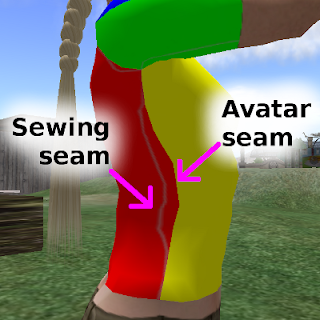


Avatar seams are the seams that inevitably happen when we match the front and back of the UV maps together around the avatar. I've coloured each UV map section a different colour, to make the avatar seams more visible.


Sewing seams are the representation of seams down the side of fleshworld clothing, and at the shoulders, the hemline, the collar, and everywhere else the fabric is pieced together.
In the example photo, the animation has distorted the avatar shape in this image - usually that seam will hang vertically. The sewing seams are the faint grey fuzzy stripes under the arm, and down the side of the body.


Avatar Seams

Avatar seams are the places where the UV maps meet.
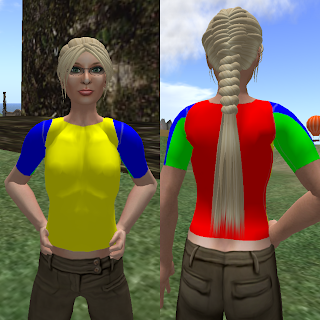

The front torso meets the back torso, both of those meet the head map, the head map has a seam down the back of the skull. The arms actually have a kind of 'top and forward' part, and a 'bottom and back' part. The torso meets the hips, and the legs have front and back sections as well - and the feet are yet another piece.


These seams can look ugly and messy - or can be invisible. Most clothing and skin makers try to make them neat, at least. I like to not just make them neat, I like to conceal them.

Not everyone agrees with me. Some designers point out that it's a fact of life - the seams exist, we have to just accept them. I feel that if you can hide them, your products look better for the effort.

Edge Matching
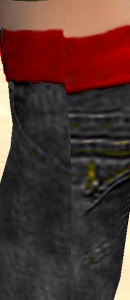
FIXME: an image of un-matched edges

Robin (Sojourner) Wood's and Chip Midnight's clothing templates have edge match guides. Using those will get you very close to a perfect match, but I've never had a pixel-perfect match from those.

I make the garment using the templates to get close to a match, then trial it on a clothing previewer. I then shave a few pixels off the longer side, or add them to the shorter side, and try again. Yes, it's tedious, but it works.

Another thing to be aware of is the fact that the avatar mesh stretches and shrinks when the shape changes. You will get the neatest edge if you design your clothing so that the avatar seam is crossed on a line in the mesh, not in one of the gaps.

FIXME: show crossing a seam on a line, show crossing a seam in a gap, show on two different sizes.

Wear the various shapes in the Designer's Toolkit while previewing your clothing, to see how your avatar seams look on the various shapes there.

Pattern or Design Matching

If you're using a fabric with a pattern or design, making the avatar seams match is one of the trickiest things to achieve. If you can pull it off, it's fantastic and I salute you. (I usually try to!)

FIXME: Show the Rowan design match.

Some are easier to match than others. When I'm making an abstract, like my Rowan leather outfit, I play with airbrush and smudge and cutting and pasting to make the seams look as if they match.

FIXME: Show the Cameron belt pattern match.

With the Cameron belted pants, I could hide the 'broken' repeats under the belt overlap: and noone expects a belt to repeat a perfect number of times around a human body anyway.

FIXME: image where design carries across av seam, breaks on sewing seam

Another option is to carry the design across the avatar seam and break it on the sewing seam. This not only disguises the avatar seam, it attracts attention to the intentional detail - the sewing seam - instead.

When I'm doing this, I start by cutting and pasting - I put the design on one side (usually the front), and lay the UV map over the top of the design layer.

FIXME: image of this stage.

Then I look at which part of the design crosses the UV map outer edge, and paste the design onto the other side (usually the back) so that, as far as possible, the design crosses the UV map at the same point.

Side note: Planning to have a centre back sewing seam is VERY useful when you're trying to match the side seams, by the way. If you're doing this, work with a different layer for each side of the back, so you don't wreck the left side while you're placing the right.

The paste is never completely right - you're going to have to modify the back to make it fit properly. So preview the garment with the approximation, and notice where you'll need to modify it.

FIXME: try to make an image showing modifications.

Usually, the modifications are just extending or shrinking the pattern enough to make it look almost right. Imagine that you're fitting a lycra swimsuit on a particularly curvy woman - think about how the patterns on such a swimsuit are stretched or shrunk when you look at it.

Once again, the key is experimentation, trial and error.

Sewing Seams

We'll be using the tutorial shirt again. This time, we'll be drawing in the sewing seams.

Try to design your main sewing seams once, and use them over and over again for different garments. Well-fitted, well-sewn garments almost always have the same key set of seams, with variation only for different types of garment construction.

Standard seams

FIXME: diagram of standard seams

Side seams in a well-fitted garment should fall vertically from the armpit to the ankle, down the line that starts from the point of the shoulder. (Almost as if you'd dropped a plumb line from the point of the shoulder.)

The centre back seam should also look as if you'd dropped a plumb bob, this time from the top of the spine.

Seams across the shoulder should go from the point of the shoulder to the one on the other shoulder, as if there was no head or neck in the middle (but, of course, interrupted by it!).

The armhole seam has the most variation of the 'standard' seams. However, the 'default' armhole sleeve starts at the point of the shoulder, drops vertically down the front and back until the halfway point, then curves smoothly to meet under the armpit, only a short distance below the actual meeting point between arm and body.

The crotch seam is another which can have a great deal of variation, but the SL version is a lot easier than the atomic-world version! In SL, just draw the crotch seam as a vertical line down the UV mesh - any shaping it needs happens automatically when you modify the 'pant looseness' slider.

Finally, all the cut edges of the garment need to be hemmed, unless they're on a selvedge. So draw in hem seams, or make a slightly different coloured edge to represent selvedge.

FIXME: make a diagram of optional seams

Variations on seams

Both Feldie and I sew, and we have fashion design books that contain diagrams of the many, many seam and garment construction variations that exist in the world. I strongly recommend hitting your local library (yes, atomic-world library rather than digital) and at least flipping through the pictures.

The diagrams you want will look something like this.

FIXME: diagram showing sleeve types, or cuff types, or bodice variations, collar variations. Maybe a blend of several.

I looked for similar diagrams online, and haven't found any. If anyone does find some, please add the URL to the comments.

Drawing seams

Once you have decided where on the body the sewing seams should be, make only the UV map layer and a white background visible. If you're doing hems, edges, or anything where the outfit outline is important, include that as well.

I find it's easiest to do seams without any distracting details.

Make a seams layer. If you're like me, make a bunch of seams layers and do each seam set on a different layer. If 'too many' layers confuse you, just have a single seams layer.

FIXME: example of seams 'placement' layer over UV maps and shirt outline.

Draw a marker where you think the seam should go. A line about four or five pixels wide will do fine. Bright red if you want it to show up clearly. This is just for placement: it's not the final seam!

Next you spend ages flipping between your previewer and the Gimp, working out that this part of the seam belongs between those UV lines. Don't worry that it looks wonky and distorted on the flat page - make it look right when wrapped around the avatar framework.

Finally, once you've placed your seams, make another new layer. Above the red line of the seam placement guides you've made, draw your seam.

FIXME: examples of both types of seam

I like to make a path along the seam line, then use the airbrush with one of the fuzzy brushes, and a dark grey. When I'm making a light garment, I make the seams layer mostly transparent. With a dark garment, I leave it more opaque. This way I have a bit of shadow along the seam line, but it's not overwhelming for the garment.

If you want to go into detail, try making a line of highlight, a line of shadow, and some 'stitches'. Make sure the highlight is where light would fall on the slight 'bump' where the seam rises, and the shadow would be in the slight 'dip'. Study atomic-world clothing seams, to get the exact placements.

For even more suggestions, check out the thread on seams from the Texturing forum.

And don't think you're finished yet! Preview your seams. You'll find that in some places (such as the crotch) the seams are stretched all yuck. And in other places, they've been shrunk narrower.

Again, there is no magic bullet. Modify, preview, modify, preview, rinse, repeat until done. BUT! Once you've done it once, you'll be able to use the same seam layer on many of your clothes - and use it as a template for other seams on other clothing!

FIXME: seamed, patterned shirt seen across the side-seam, showing both concealed avatar seam and sewing seam.

And .. that's it. That's how to put seams on clothes.

Tuesday, June 2, 2009

Update to Highlights & Shadows tutorial

I discovered a new feature in the Gimp. Okay, an old feature, but new to me. It's amazing for highlights and shadows, so that's where I put it.

Check out the new "Other layer types" section near the bottom of the Highlights & Shadows tutorial.